// overview
What happened
Stuxnet was unprecedented in scope, sophistication, and intent. Its 500-kilobyte payload chained four Windows zero-days (a record in a single piece of malware) with stolen code-signing certificates to install rootkits, then waited until it found Siemens Step7 software controlling specific PLC configurations matched only by Iran's Natanz enrichment cascade.
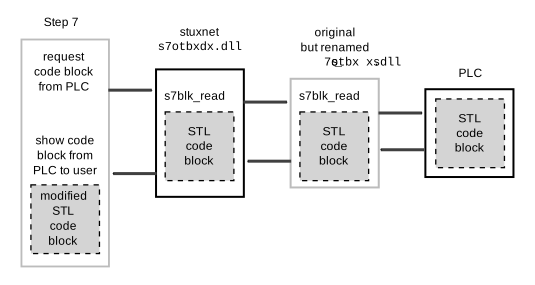
Once inside the target environment, Stuxnet did not exfiltrate data. It periodically increased centrifuge rotor speeds from the design 1,064 Hz to 1,410 Hz, then slowed them, putting destructive stress on the bearings — while simultaneously replaying recorded normal telemetry to the SCADA monitoring systems so that operators saw nothing wrong.
Belarusian antivirus firm VirusBlokAda found the worm in June 2010 after it spread beyond its intended target. Symantec, Kaspersky, and the German researcher Ralph Langner spent months reverse-engineering it before concluding it could only have been built by a nation-state with deep knowledge of Natanz's specific equipment.
Journalists Kim Zetter and David Sanger later reported the joint US–Israeli origin, codenamed Operation Olympic Games. Neither government has officially confirmed authorship. Stuxnet's source code, design, and supporting frameworks (Duqu, Flame) became the seed library for an entire generation of nation-state malware.
// timeline
How it unfolded
2005–2007
Operation Olympic Games initiated under President George W. Bush.
Jun 2009
Earliest Stuxnet variants detected in field samples.
Jun 17, 2010
VirusBlokAda reports an unknown worm using a Windows LNK zero-day.
Sep 2010
Symantec and Langner publish analysis linking the worm to Siemens PLC sabotage.
Nov 2010
Iran acknowledges malware affected centrifuges at Natanz.
Jun 2012
NYT confirms US/Israeli origin in reporting by David Sanger.
// damage
Impact and scale
Stuxnet was the first weapon made entirely of code that physically destroyed real-world equipment. By manipulating centrifuge rotor speeds while feeding fake telemetry to monitoring systems, it forced operators to chase phantom mechanical faults for years. The attack normalised state-sponsored cyber operations against critical infrastructure — a Pandora's box that every nation now operates inside.
// affected
Who was hit
- Iran's Natanz uranium enrichment facility (~1,000 centrifuges destroyed)
- Iranian nuclear program (estimated 1–2 year setback)
- ~200,000 Windows systems globally as collateral propagation
- Industrial control system trust: every utility and plant now lives in a post-Stuxnet world
// lessons
Key takeaways
- Air-gapped networks are not invincible — Stuxnet crossed the gap on USB drives carried by trusted contractors.
- Operational technology (OT) requires its own threat model; IT security assumptions do not transfer.
- Stolen code-signing certificates from legitimate vendors render driver-signing protections moot.
- Once a state demonstrates a capability, the techniques become the public-domain playbook for everyone else.